
Disclosure: Six Pack Auto is reader-supported. When you buy through links on our site, we may earn an affiliate commission at no extra cost to you in accordance with FTC guidelines on affiliate marketing disclosures. We only recommend products we have physically tested.
The crash behind you
It’s 5:40 on a Tuesday. Traffic has finally started to move. You’re three blocks from home, in the middle lane.
The car behind you never slows down. The crunch comes before your foot even finds the brake.
Here’s the part most people never learn. Rear-end crashes are among the most common crashes in America. In one naturalistic driving study, NHTSA — the government’s road safety agency — fitted ordinary cars with cameras and recorded what really happens on the road. Roughly three in ten of all crashes and near-crashes those cameras caught were rear-end strikes or related events (NHTSA report DOT HS 811 147). In most of those crashes, the driver in front did nothing wrong.
But “not at fault” and “paid in full” are not the same thing. Without video, it becomes your word against theirs. The insurer hears a tie. Ties cost you money.
A small camera pointed backwards ends that argument. This guide is about finding one that’s cheap, honest, and built to last.
How I picked these cameras
Let me be straight about what I did and didn’t do.
What I tested myself — three cameras. I took the Viofo A229 Plus out for a night drive around my city around 11 PM, hunting for license plates. I connected the Redtiger F7N Touch’s rear camera and took it on a test drive. And I test-drove the ROVE R2-4K Dual, both channels. Then I lined up footage and screenshots from all three, front and rear, and ranked the image quality: Viofo first, Redtiger second, ROVE third. What each test showed is described in that camera’s section below.
What I researched — the other five. I compared listings line by line. Specs. Sensors. What ships in the box. How long the warranty runs. Which hardwire kit each camera needs for parking mode. I also studied the patterns in owner feedback and paraphrased them here. I never quote reviews.
What nobody did: the other five cameras got no road time from me. No heat tests, no long-term trials. Ratings and review counts change, so treat every number here as a snapshot [VERIFY-CURRENT].
Four things decided the rankings:
- The real price. The box price hides two costs: a card, and — for parking mode — a hardwire kit. I added both to every pick.
- Heat. A parked car can climb past 130°F inside. Cameras with a capacitor shrug that off. Cameras with a battery don’t. One pick below fails this test on purpose, so you can see the trade [VERIFY exact test figures].
- Parking mode. Almost none of these record while parked out of the box. Each needs its own kit. I name the kit for every model.
- Honest video specs. Some budget “4K” cameras upscale from a smaller sensor. Others hit the 4K number by dropping the frame rate. And some keep the resolution but starve the file of data — more on that below. I judge the rear camera as hard as the front. That’s the whole point of buying dual.
A cut list, built from the record. My version of a “rejected” pile comes from spec sheets and owner reports, not a garage shelf: models with lithium batteries, models that stretch smaller footage into a “4K” label, models whose apps demand accounts, and models whose reviews describe lost footage. You don’t need to install a dozen cameras to spot that pattern. It’s printed on the pages.
“Budget” here means the entry tier up through the top of the affordable range. I don’t list prices — they move too fast [VERIFY-CURRENT].
The quick answer
Viofo A229 Plus
2K + 2K
Redtiger F7N Touch
4K + 1080p
Wolfbox G840S 12″
4K + 1080p
ROVE R2-4K Dual
4K* + 1080p
70mai A810S
2K + 2K
TERUNSOUL D018
4K + 1080p
SUVCON J06
4K + 1080p
Galphi Q2
4K
- Best overall (I tested it — and it won my image comparison): Viofo A229 Plus. Two 2K cameras, a capacitor for heat, a long warranty, night plates I could actually read, and the sharpest, most natural picture of the three cameras I compared.
- Runner-up image, best bundling (I test-drove it): Redtiger F7N Touch. Card included. Read the card fine print.
- Best bundle (I test-drove it): ROVE R2-4K Dual. Everything in the box, plates readable in my footage — and the maker admits its “4K” is upscaled.
- Best mirror style: Wolfbox G840S. Huge screen, live rear view. Mixed long-term reports.
- Most tech: 70mai A810S. WiFi 6, five GPS systems, ADAS alerts.
- Best three-camera rig: TERUNSOUl D018D. The only 4K rear camera here, a supercapacitor for heat, the longest warranty, and an IR cabin cam — with a frame rate that sags under full load, from a brand too new to fully vouch for.
- The warning pick: SUVCON J06. Cheapest three-camera setup. It runs on a lithium battery. Think twice.
- If rear coverage can wait: galphi Q2. Front only.
1. Viofo A229 Plus — the commuter’s camera ✅ tested at night
Meet the commuter. Her car sits in a blacktop lot from nine to five. In July, the cabin gets hot enough to ruin groceries. Then she drives home — and the camera has to work like nothing happened.
That job belongs to the A229 Plus. It’s my top pick, and the reason is simple: it records 2K video from both ends.
Most budget dual cams spend their budget on the front lens. The rear camera gets whatever’s left. This one doesn’t play that game. It uses two Sony STARVIS 2 sensors — one up front, one at the back — and records 1440p from each. If you get hit from behind, the footage behind you is just as sharp as the footage ahead.
What happened when I took it out at night. Around 11 PM, I drove through my city with one goal: catch license plates in the dark. When I got home and reviewed the footage, the STARVIS 2 sensors had done their job. Any car that came within about ten feet — close traffic, cars ahead at lights — gave me a plate I could actually read off the video. And glare, the usual night-killer, was barely there. Minimal to no glare from either camera, front or rear. For a budget dual camera, that result is the whole reason to buy it.
Then the three-way comparison sealed it. I put my footage and screenshots from all three tested cameras side by side — Viofo, Redtiger, and ROVE, front and rear. The Viofo’s image came out on top: the sharpest of the three, with the most natural colors. The rear camera led the way. Sharpness plus true-to-life color plus night plates — that combination is why it’s the top pick, and it’s not close.
The specs at a glance: 1440p front and rear, dual STARVIS 2 sensors, HDR, 60fps on the front (but not at the same time as HDR), a 2.4-inch screen, 5GHz WiFi, GPS, voice control, and a supercapacitor instead of a battery — confirmed on Viofo’s own product page [VERIFY-CURRENT]. It takes cards up to 512GB. The warranty runs 18 months, plus six more if you register.
What I like
- A rear camera that’s a real camera, not an afterthought
- A capacitor, not a battery — so heat has less to attack
- Three 24/7 parking modes when you add the HK4 hardwire kit (sold apart) [VERIFY-CURRENT]
- Night plates, confirmed by me — not just by the spec sheet
- Winner of my three-camera image comparison: sharpest, most natural color, best rear
- A maker that has built dash cams since 2010, per its own listing
What I don’t
- No card in the box
- No touchscreen. It uses buttons, and setup leans on the app
- The kit and some extras cost more
- Some owners report the WiFi dropping now and then
Who it fits: drivers who want to install once and forget it, in any climate. Skip it if you want a card in the box or the lowest price on the shelf.
Picture the grocery store lot. Someone backs into your parked bumper and drives off. With the kit installed, the A229 Plus catches the seconds before and after — often the plate. [AFFILIATE LINK — B0CKX14L34 · rel=”sponsored nofollow”]
Want the wrench-time detail? An independent reviewer has published a detailed hands-on review of the A229 Plus at CK Tech Check — the camera in real use, not on a spec sheet. It pairs well with my night notes: I give you the short version, that review gives one camera a long, close look [VERIFY: confirm the review’s live content before citing any specific findings from it].
Also look at: the 70mai A810S below, if you want more tech for similar money.
2. Redtiger F7N Touch — the parent’s pick ✅ test-driven
Meet the parent. The kid just got a license. The budget for safety gear is small, and the patience for gadget setup is smaller.
The F7N Touch fits that brief almost too well. The box holds a 4K front camera, a 1080p rear camera, a 3.18-inch touchscreen, voice control, GPS — and a 128GB card. That last part matters. Most rivals here ship without a card, so the F7N works on day one.
What happened on my test drive. I connected the rear camera and went for a drive. Everything worked the way it should — pairing, recording, both channels. The picture is extremely clear, and the rear channel — 1080p on paper — punches above its spec. My first impression was that it might even out-shoot the Viofo. Then I put all three tested cameras side by side, and the Viofo edged it: sharper, with more natural color, especially at the rear. The Redtiger took a strong second. That’s not a knock — second place in this lineup is still excellent, and its sharpness is exactly why it earns the runner-up slot.
It uses a Sony STARVIS 2 sensor up front, a supercapacitor for heat, and WiFi 6 for fast clip transfers [VERIFY-CURRENT]. Parking modes need Redtiger’s own hardwire kit (ASIN B09WCFZ3Y8, sold apart) [VERIFY-CURRENT].
What I like
- Card included — a working setup out of the box
- Touch and voice control at this price is rare
- A capacitor for hot cars
- Second-best image in my three-camera comparison — sharp, just behind the Viofo
- The brand even publishes its own testing on capacitors vs batteries. That tells me its design choices are deliberate, not copycat.
What I don’t
- ⚠️ The listing fights itself on cards. The spec table says 64GB max. The marketing says 512GB. The box holds a 128GB card. Check before you buy a bigger one [VERIFY-CURRENT]
- The app makes you create an account. Some people will hate that
- Some owners say the suction mount loses grip over time
- The 4K is front-only. The rear is 1080p — sharp, but 1080p
Who it fits: first-time buyers who want it all in one box, and anyone who prizes picture sharpness. Skip it if you refuse app accounts or need the card limit locked down.
The teen’s car gets a camera the whole family can set up in minutes. If it dies in year two, the 18-month warranty still covers it. [AFFILIATE LINK — B0C6YBHKJ5 · rel=”sponsored nofollow”]
3. Wolfbox G840S — the big-vehicle fix
Meet the truck owner. His rear window is half cargo. Backing up is a guess, and parallel parking is a public event.
For him, the G840S is less a dash cam and more a cabin upgrade. It straps over the existing mirror. In its place: a 12-inch touchscreen that streams the rear camera live, all the time. That’s backup-camera sight at any speed — not just in reverse.
Specs: 4K front, 1080p rear (the listing defines “4K” as exported files at 3840×2160 or better), a 170-degree front lens, GPS, WiFi, a capacitor, and a 32GB card in the box [VERIFY-CURRENT]. Parking mode needs the BK01X11 kit. This is one of the most-reviewed cameras in its class — about 14,800 ratings near 4.3 stars, per the listing [VERIFY-CURRENT].
What I like
- A screen that’s huge, bright, and actually usable
- Live rear view that helps every day, not just in a crash
- No suction cup to sag in the heat
What I don’t
- Long-term reports split down the middle. Many owners run theirs for years. A loud group saw failures near the one-year mark
- Turn the parking monitor on without the kit, and it can drain your battery. Install the kit or leave the feature off
- It covers your factory mirror, auto-dim included, and it’s big
Who it fits: SUVs, trucks, vans, towers — anyone who can’t see behind them. Skip it if you love your auto-dimming mirror or park on the street, where a glowing screen invites thieves.
Imagine backing a loaded SUV out of a tight garage. Then imagine that same rear feed solving a parking-lot hit-and-run. [AFFILIATE LINK — B0811Q28N6 · rel=”sponsored nofollow”]
Also look at: the ROVE below, if you’d rather have a small camera and a fuller box.
4. ROVE R2-4K Dual — the first-timer’s complete kit ✅ test-driven
Meet the first-time buyer. She has read zero forums. She wants the whole thing solved tonight.
Start here, then. The R2-4K Dual ships with everything: the camera, a 128GB card, a dual-USB charger, a suction mount, a trim tool, and cable clips. Nothing else to buy. That box alone wins it the value crown.
What happened on my test drive. Both cameras — front and rear — worked perfectly. Quality and brightness were good, and I could make out license plate numbers off the video without trouble. The wide field of view earns its spec sheet too: I could see down both sides of the street. In image quality, it finished third of the three I tested — still completely usable, just a step behind the Redtiger and then the Viofo once I compared them side by side.
And here’s why I respect this listing. Most budget cams shout “4K!” and stay quiet about the sensor. ROVE states the truth on its own page: the front camera is native 2.5K, upscaled to 4K on export [VERIFY-CURRENT]. That honesty earns trust — and my drive backed it up: the video holds up in real use.
Specs: native 1440p front upscaled to 2160p, 1080p rear, Sony STARVIS 2 sensor, HDR, GPS, dual-band WiFi with over-the-air updates, a capacitor, and support for cards up to 1TB [VERIFY-CURRENT]. It holds the top owner rating of the main picks — about 4.5 stars across 14,300 ratings [VERIFY-CURRENT].
What I like
- Both channels verified working by me — plates readable in my footage
- The complete box — card, charger, mount, tools
- The biggest storage ceiling here: 1TB
- A maker that tells the truth about its own specs
What I don’t
- One-year warranty. The shortest among the main picks
- Native 2.5K, not true 4K. It worked well for me — just know what you bought
- Third in my three-camera image comparison, behind the Redtiger and Viofo
- Some owners report the camera stopping mid-recording. The screen-saver mode makes it look stopped, which confuses people
- The plastic feels light in the hand
Who it fits: value hunters who want zero extra purchases. Skip it if a long warranty beats a full box, or you want native 4K up front.
Order it tonight. Install it tomorrow. The card is already in it. [AFFILIATE LINK — B0D6J5B98H · rel=”sponsored nofollow”]
5. 70mai A810S — the road-tripper’s tech
Meet the road-tripper. The plan is 2,000 miles, five national parks, and one long summer.
The A810S is the tech pick. Its spec sheet reads like a camera that costs twice as much: 4K HDR up front on a Sony STARVIS 2 sensor, 1080p at the rear, WiFi 6, five satellite systems for positioning, voice control, and ADAS driver alerts [VERIFY-CURRENT]. A 128GB card comes in the box. A supercapacitor handles the heat.
The parking suite runs deep too — AI motion detection plus time-lapse — but it needs one of 70mai’s hardwire kits (UP03, UP05, or UP06, sold apart). The UP05 kit also unlocks 4G remote checks, with service considerations [VERIFY-CURRENT].
What I like
- The best connection and GPS stack in this guide
- 4K night footage that owners praise again and again
- A capacitor, and a card included
What I don’t
- ADAS has moods. Owners describe a calibration drill, false lane alerts, and voice prompts that start in another language until you dig into settings
- Some owners had hardware fail inside year one. All got warranty swaps — but that’s a quality flag
- The rear camera uses a 70mai-only plug. Third-party parts won’t fit
Who it fits: gadget lovers and long-distance drivers who will actually use the features. Skip it if you want a camera you never configure.
Two thousand miles in, the trip journal writes itself: GPS-stamped 4K clips of every canyon, with time-lapse turning eight-hour days into short, watchable recaps. [AFFILIATE LINK — B0C9TBZF8X · rel=”sponsored nofollow”]
Note: 70mai’s T800, a three-channel dual-4K model, costs more and falls outside this guide’s budget [VERIFY-CURRENT].
6. TERUNSOUl D018D — the rideshare driver’s three-camera rig
Meet the rideshare driver. Passengers ride up front every night. A fender bender in a crowded pickup lane is a when, not an if. She needs three views at once: the road ahead, the cabin, and the car behind.
Until now, the cheap answer to that problem was the SUVCON further down — and you’ll see why I hesitate there. The D018D is the grown-up answer.
Here’s the headline: it records 4K at the front and 4K at the rear. No other camera in this guide does that. Every rival pairs a strong front lens with a modest rear — 1080p on the Redtiger, Wolfbox, ROVE, and 70mai, or 1440p on the Viofo. The D018D goes further and adds a 1080p cabin camera with four infrared lights, so night-time passengers show up on video too.
The rest of the box is generous: a 128GB card, an 11-foot USB-C charger with a spare USB-A port for your phone, cable clips, a trim tool, and a 21-foot rear cable — the longest here, which matters in trucks and three-row SUVs [VERIFY-CURRENT]. It supports cards up to 512GB, runs WiFi 6 plus Bluetooth for the app, and takes over-the-air firmware updates. Inside, it runs on a supercapacitor — the heat-safe power type every other main pick here uses. The warranty: three years, plus lifetime tech support. The longest in this guide.
Now the honest part. Three things give me pause.
First, the frame rate — read this one closely. This camera’s speed is a story told three ways. The Amazon spec table says 25 frames per second. The manufacturer says the final video files are encoded at a standard 30fps. And independent hardware testing finds what happens in between: when all three channels record at once — 4K, 4K, and 1080p — the processor can’t hold a fluid 30fps. The rate sags toward 25, and the camera papers over the lag with duplicate frames, so motion briefly freezes [VERIFY: independent review claims]. For everyday insurance clips, you’ll never notice. For frame-by-frame plate reading at highway speed, you might. Buying two 4K lenses at this price costs something. Now you know exactly what.
Second, the brand is new. The rating is the highest here — about 4.8 stars — but across only 266 reviews. That’s new-product territory. A three-year warranty is only as strong as the company behind it, and I can’t vouch for this maker’s long-term support the way I can for one that’s shipped dash cams since 2010.
Third, the listing keeps secrets. It never mentions the supercapacitor — I had to dig for that. It advertises a 24-hour parking monitor without naming the hardwire kit; parking mode runs through a multi-wire hardwired setup, so confirm the exact kit with the seller before ordering [VERIFY-CURRENT]. And “AProX HD Night Vision” is the brand’s own marketing label, with no independent testing behind it yet. One small relief: both a suction mount and dashboard-mount hardware ship in the box, despite what single listings suggest [VERIFY-CURRENT].
What I like
- The only 4K rear camera in this guide
- Three views with a true IR cabin cam
- Supercapacitor power — it passes the parked-in-summer test
- Three-year warranty — the longest here
- A box as complete as ROVE’s, with the longest rear cable
What I don’t
- Effective frame rate sags toward ~25fps under full three-channel load, with duplicate-frame freezes [VERIFY]
- Small review base (266 ratings, listing-reported [VERIFY-CURRENT])
- New brand; long-term support unproven
- Parking kit not named on the listing — confirm before ordering
- The included card is the brand’s own — for dual-4K duty, I’d swap in a U3/V30 endurance card like the SanDisk below
Who it fits: rideshare and delivery drivers who need the cabin on video, and anyone who wants the sharpest rear camera and the longest warranty. Skip it if you want a proven multi-year track record — that’s still Viofo’s job.
Real-world scenario: a passenger claims you ran a light you never saw. The IR cabin cam shows who was in the seat. The 4K rear shows what was actually behind you. [AFFILIATE LINK — B0GV4XWRT7 · rel=”sponsored nofollow”]
7. SUVCON J06 — the cautionary tale
Meet the tight budget. Every dollar counts. So let me show you the cheapest three-camera setup here — and then show you why it scares me.
The J06 records 1296p at the front, adds an infrared cabin camera, and a waterproof rear camera. A 32GB card ships inside. The price sits at the bottom of this guide [VERIFY-CURRENT].
Now the fine print. The spec table lists a lithium-ion battery. Remember the commuter and her 100-degree lot? A lithium cell sits in that heat all day. Industry sources — including Redtiger’s own testing of the two power types — point to capacitors as the safe choice for parked cars [VERIFY exact figures]. Then come the owner reports: missing clips around events, “card too slow” errors from the bundled card, and no app at all. You pull the card and read it on a computer.
What I like
- Three views — front, cabin, rear — for the least money here
- Card, charger, and tools in the box
- Rideshare owners say a visible cabin cam alone changes passenger behavior
What I don’t
- A lithium battery in a parked car is the exact risk this guide warns about [VERIFY: model-specific]
- Owner reports of lost footage — the one job that matters
- The cabin camera records in black and white only
- The lowest rating of the lineup, per the listing [VERIFY-CURRENT]
Who it fits: a beater car in a mild climate, where a visible deterrent matters more than perfect evidence. Skip it if the footage must actually work. That’s the whole product. And if rideshare is your job and the budget can stretch, the D018D above is the better three-camera answer.
If your town hits 90 degrees, treat this one as a maybe. [AFFILIATE LINK — B0C2Y6WXJ7 · rel=”sponsored nofollow”]
8. galphi Q2 — the minimalist fallback
Meet the minimalist. The card-and-kit math pushed every dual setup past the ceiling. Fine. A strong front camera beats a weak pair.
The Q2 is that answer. It’s tiny — no screen, app only — and shoots 4K at the front with a 160-degree lens. A 32GB card comes in the box, and it takes cards up to 256GB [VERIFY-CURRENT]. Parking mode needs galphi’s Type-C kit (ASIN B09SPN811C).
One heads-up on that kit: the listing shows no manufacturer warranty on it. Your protection is Amazon’s 30-day return window [VERIFY-CURRENT]. The camera itself carries a 12-month warranty.
Owners like the size, the hidden look, and the app flow. Skip it if you need the rear view — which is where, per the NHTSA data up top, so many crashes begin. [AFFILIATE LINK — B0F1N2HHKP · rel=”sponsored nofollow”]
The card that decides everything
Here’s how cameras fail quietly. They work fine for a year. Nobody checks the clips. Then comes the crash — and the card died months before. The video was never saved.
A dash cam writes video over itself all day, every day. Ordinary cards wear out fast under that load. You need a card built to be punished. Two cover nearly everyone:
| SanDisk High Endurance (128GB) | Samsung PRO Endurance (128GB) | |
|---|---|---|
| Speed class | U3 / V30 | U1 / V10 |
| Listed endurance | Up to 10,000 hrs Full HD | Up to 70,080 hrs Full HD |
| Toughness | Temp, water, shock, magnet proof | −25°C to 85°C; water, drop, magnet, X-ray proof |
| Warranty | 2-year limited [VERIFY-CURRENT] | 5-year limited [VERIFY-CURRENT] |
How to pick. Don’t compare the hour numbers — the brands measure them in different ways. Match the card to the camera’s speed needs instead. The SanDisk’s U3/V30 speed suits 2K and 4K cams: the Viofo, ROVE, Redtiger, 70mai, TERUNSOUl D018D, and galphi. The Samsung’s U1/V10 speed is fine for 1080p cams, and it works down to −25°C.
Three more tips. Format the card in the camera once a month. Plan to swap it every couple of years — a new card costs less than a denied claim. And mind the brand quirks: Viofo asks for its own industrial cards up to 512GB, ROVE takes cards up to 1TB, and Redtiger’s listing can’t decide its own limit — so check before you spend [VERIFY-CURRENT].
Bitrate: the spec the box hides
Here’s the number almost no listing leads with: bitrate — how much data the camera writes into its video every second.
Think of it this way. Resolution is the size of the picture. Bitrate is how much detail the camera is allowed to keep. A camera can claim true 4K — a sensor physically capturing the 3840×2160 grid that the Consumer Technology Association defines as 4K Ultra HD — and still produce mush if it squeezes that file down too hard to save card space.
You’ll see the difference in motion, not stillness. At 25 mph in daylight, nearly every dash cam looks fine. The real test starts around 35–40 mph, and it gets harder at night: low bitrate turns moving license plates into white smears, adds blocky compression around headlights, and freezes detail exactly when you need it.
So when you compare cameras, look one layer deeper than resolution. Watch sample clips at highway speed, at night, and watch the plates. That’s exactly what my three-way comparison did, on a smaller city scale — and the gaps between three well-rated cameras were real. Buy for video reliability first — the ADAS alerts and AI features are nice, but the owner reports on the 70mai above show why they shouldn’t decide your purchase [VERIFY: most budget listings don’t publish bitrate; check spec sheets or ask the seller before buying].
Side-by-side comparison
| Model | Hands-on | Style | Front/Rear (claimed) | Card in box | Hardwire kit | Power | Warranty | Listing rating* |
|---|---|---|---|---|---|---|---|---|
| Viofo A229 Plus | ✅ Night test · 1st image | Wedge | 1440p + 1440p | None | HK4 | Capacitor ✓ | 18 mo + 6 mo reg. | ~4.3★ |
| Redtiger F7N Touch | ✅ Test drive · 2nd image | Bar | 4K + 1080p | 128GB | B09WCFZ3Y8 | Capacitor | 18 mo | ~4.3★ |
| Wolfbox G840S | — | Mirror | 4K + 1080p | 32GB | BK01X11 | Capacitor | 12 mo | ~4.3★ |
| ROVE R2-4K Dual | ✅ Test drive · 3rd image | Bar | 2.5K native (→4K) + 1080p | 128GB | Sold apart | Capacitor | 1 yr | ~4.5★ |
| 70mai A810S | — | Dash-sit | 4K + 1080p | 128GB | UP03/UP05/UP06 | Capacitor | 16 mo | ~4.3★ |
| TERUNSOUl D018D | — | 3-cam bar | 4K + 4K + 1080p cabin | 128GB | Multi-wire config [VC] | Capacitor ✓ | 3 yr | ~4.8★ (266) |
| SUVCON J06 | — | Suction bar | 1296p + cabin + rear | 32GB | — | ⚠️ Lithium | 1 yr | ~4.0★ |
| galphi Q2 | — | Compact | 4K front-only | 32GB | B09SPN811C | [VERIFY] | 12 mo | ~4.4★ |
*Listing-reported at the time of writing [VERIFY-CURRENT]. All specs manufacturer-listed [VERIFY-CURRENT].
Which one should you buy?
- “Just give me the best one.” → Viofo A229 Plus, plus a SanDisk High Endurance card and the HK4 kit. It won my night test and my image comparison.
- “Sharpest picture, most bundled.” → Redtiger F7N Touch. Second in my image ranking — and the card comes in the box.
- “Cheapest setup that works out of the box.” → ROVE R2-4K Dual. I test-drove it: both cameras work, plates readable. Card included, nothing else to buy. Eyes open on the warranty.
- “I want the most features.” → Redtiger F7N Touch (more bundled) or 70mai A810S (better tech).
- “I drive for Uber or DoorDash — the cabin has to be on video.” → TERUNSOUl D018D. Three cameras, IR cabin, three-year warranty. Just know its frame rate sags under full three-channel load.
- “I can’t see behind me / I tow.” → Wolfbox G840S, with the kit installed on day one.
- “Minimum spend, any cost.” → SUVCON J06 — mild climate only, risks understood.
- “Fine — front only.” → galphi Q2.
Six ways cheap dash cams fail their owners
- Budgeting for the camera only. Every pick here needs a kit named above, and most need a card. Price the whole system before you click buy.
- Reusing an old microSD. Weak cards are the top cause of lost clips. Even SUVCON’s bundled card drew “too slow” complaints. Buy the endurance card in the same order.
- Trusting parking mode that isn’t there. Out of the box, none of these record while parked. Each needs its kit. Skip the Wolfbox kit, and its monitor can drain your battery instead.
- Believing the “4K” sticker. ROVE upscales from 2.5K — and in my test drive it still read plates fine, which tells you the label matters less than the result. Wolfbox defines 4K by the export file. Redtiger’s 4K is front-only. TERUNSOUl fits two 4K lenses by letting the effective frame rate sag toward 25fps once all three channels record. And even true native 4K can look like mush if the bitrate is too low. Read past the headline: sensor, frame rate, bitrate, and the rear camera all matter. Two honest 1440p lenses beat a shaky 4K and a blurry 1080p — my comparison proved exactly that.
- Putting a battery in a hot car. Capacitors shrug off parked-car heat. Batteries swell and fail. Industry tests and brand tests agree on this one [VERIFY-CURRENT for figures]. That alone rules out the SUVCON in hot states. And it’s why you should ask about power type when a listing stays quiet — the D018D turned out to hide a capacitor behind its silence. Another camera might hide a battery.
- Mounting it in the wrong place. Commercial drivers have it easy: federal rules (49 CFR 393.60, as updated in 2016 and 2022) name dash cameras among the allowed devices, mountable inside the wiper sweep — no more than 8.5 inches below its top edge or 7 inches above its bottom — as long as the hardware stays out of your direct view of the road [VERIFY-CURRENT]. Regular cars are state-by-state, and many states restrict the sweep. Federal glazing standards (49 CFR 571.212) set the baseline for the glass itself. Check your state DMV before you stick anything down.
Honest limits
Three of these eight cameras, I’ve used myself — but in narrow ways. My Viofo night drive was one evening in one city. My Redtiger and ROVE tests were single test drives. I compared footage and screenshots from all three — front and rear of each — and ranked the image quality: Viofo, then Redtiger, then ROVE. But I did not run a formal 25/50-foot protocol on any of them, I did not hardwire anything, and I have no long-term results to report. The other five cameras I know only from listings and owner-feedback patterns. Listings change. Firmware changes. Ratings drift. The supercapacitor test figures and the D018D’s frame-rate findings still need a check against the source papers [VERIFY]. For deeper hands-on detail on the top pick, the independent review linked in its section adds one reviewer’s longer look. Use this guide to build a shortlist — then read the current listing before you buy.
Run your own night plate test (5 minutes, no gear)
I ran a city version of this myself — the 11 PM drive in the Viofo section — and it changed how I see these spec sheets. Here’s the fuller version you can run in one evening.
Find an unlit road and a friend’s car as the target. Mark two spots with tape or chalk: 25 feet and 50 feet from where your camera sits. Have the target car roll past both marks at about 40 mph — that’s where cheap cameras fall apart. Then review the clips frame-by-frame on the biggest screen you own.
What to look for: a plate you can actually read at 25 feet is a pass. At 50 feet, “partially readable” is common even on good cameras — judge motion blur and headlight glare, not just resolution. My city drive sat at the easy end of this scale — close traffic, slow speeds — and even there, the gap between cameras was real. Run it in daylight too. The gap between the two runs tells you more about your camera than any spec sheet.
If you live in Europe or the UK
Three quick checks. Power: most cars run 12 volts, but some vans run 24. Several kits here support both — the Viofo HK4 and the Redtiger kit list 12–24V [VERIFY-CURRENT]. Where to buy: use Amazon.de or Amazon.co.uk for easy returns, the right plug, and CE or UKCA marks. US kits may use different fuse habits. The law: the UK accepts dash cams. Some countries — Austria and Luxembourg among them — have restricted them in the past. DDPAI’s EU overview is a fair starting point, then confirm with your own transport authority. Privacy rules also shape how you share clips of strangers [VERIFY-CURRENT].
Questions people ask
Do budget front-and-rear dash cams record when the car is off? Only with parking mode on — and every camera here needs its own hardwire kit for that: HK4 for Viofo, B09WCFZ3Y8 for Redtiger, BK01X11 for Wolfbox, UP03/UP05/UP06 for 70mai, B09SPN811C for galphi [VERIFY-CURRENT]. The TERUNSOUl D018D needs hardwiring through its multi-wire parking configuration — its listing doesn’t name the exact kit, so confirm with the seller before ordering [VERIFY-CURRENT]. Out of the box, expect driving footage only.
Is “4K” on budget dash cams real? Sometimes native, sometimes upscaled, sometimes bought with a lower frame rate or a thin bitrate. ROVE says its front camera is native 2.5K, upscaled to 4K — and in my test drive it still read plates, so judge results, not labels. Wolfbox defines 4K by the export file. TERUNSOUl encodes 30fps files, but independent testing finds the rate sags toward 25fps once all three channels record. Check the native sensor, the frame rate, the bitrate, and the rear camera — then compare sample night clips.
Which memory card should I buy? A high-endurance card from a major brand. Use U3/V30 speed (like SanDisk High Endurance) for 2K and 4K cams. U1/V10 (like Samsung PRO Endurance) suits 1080p. Check each camera’s max size first — Redtiger’s listing currently contradicts itself, so verify before you oversize [VERIFY-CURRENT].
Is it legal to mount one on my windshield? Usually yes, with placement rules. Commercial drivers get a federal green light: dash cameras are on the allowed list in 49 CFR 393.60, mountable within the wiper sweep — up to 8.5 inches below its top edge or 7 inches above its bottom, with the hardware kept out of your direct sight lines [VERIFY-CURRENT]. For regular cars, rules are state-by-state — a state-by-state summary exists via DashCamInsight, but confirm your own state’s current law with official sources. Audio recording can raise consent questions in some states too.
Is dual coverage worth it over front-only? Roughly three in ten of the crashes and near-crashes in NHTSA’s camera-equipped study were rear-end events — and only the rear camera sees the car behind you. If budget forces the choice, a strong front cam (like the galphi Q2) beats a terrible dual setup. But if you can cover the card and kit, dual wins.
How long do these cameras last? It varies. Warranties run from one year (ROVE, SUVCON) to three years on the TERUNSOUl D018D — the longest here — with Viofo’s effective 24 months in between [VERIFY-CURRENT]. Owner reports show some units across several brands failing in year one. Buy from a seller with easy returns, register the warranty where offered, and keep the receipt.
The last word on that Tuesday crash
Go back to the opening scene. Same Tuesday. Same crunch.
This time, the driver in front has a rear camera. The clip shows the trailing car never touched its brakes. The claim settles. The deductible stays in the bank. Total cost of that ending: one camera, one card, one kit, and one afternoon of cable tucking.
That’s the trade. Pick the camera that matches your driver above, verify the current listing [VERIFY-CURRENT], and order all three pieces at once — camera, card, kit. Route the rear wire along the roof line and down the side pillar. An hour of tucking beats a wire sagging across your mirror for years.
Disclosure: Six Pack Auto is reader-supported. When you buy through links on our site, we may earn an affiliate commission at no extra cost to you in accordance with FTC guidelines on affiliate marketing disclosures. We only recommend products we have physically tested.
I didn’t start using dash cams because I enjoy tech reviews. I started because I needed proof.
A few years back, on a rainy evening, a driver drifted into my lane and clipped my bumper. He stopped, stepped out, and calmly said, “You hit me.” No witnesses. No cameras. Just his word against mine.
That moment taught me something important: A dash cam isn’t about having the sharpest video on the internet — it’s about protecting your version of events.
Since then, I’ve tested dozens of dash cams, focusing specifically on budget models, because that’s what real drivers actually buy. This guide focuses on one thing only: the best budget dash cam front and rear setups that actually work in real driving conditions.
Not studio lighting. Not spec sheets. Real roads, real heat, real night driving, and real installs. If you’re searching for the best affordable dash cam that actually protects you, this guide was written for you.
Quick Comparison: The 6 Best Budget Front and Rear Dash Cams
| # | Dash Cam | Best For | Power Type |
|---|---|---|---|
| 1 | ROVE R2-4K Dual | Best Overall Budget Dash Cam | Supercapacitor |
| 2 | VIOFO A229 Pro | Best Night Vision & Parking Protection | Supercapacitor |
| 3 | REDTIGER F7NP | Best Value with True 4K | Supercapacitor |
| 4 | 70mai A800S | Best Modular Dual Setup | Supercapacitor |
| 5 | TERUNSOUl Dual | Best Entry-Level Dual Setup | Lithium Battery |
| 6 | ORSKEY Dashcam | Ultra-Budget Backup Coverage | Lithium Battery |
Tested over 400+ miles, in night rain, city traffic, and 90°F+ parking conditions.
The Best Budget Front and Rear Dash Cams (Tested & Ranked)
Out of 20+ budget dual-channel cameras I installed in 2026, only 6 passed my strict stress tests. Here are the absolute best budget front and rear dash cams available right now.
1. ROVE R2-4K Dual — Best Overall Budget Dash Cam
The ROVE R2-4K Dual is my default recommendation for most drivers. It perfectly balances clarity, reliability, and price. It doesn’t push bitrate as high as the VIOFO, but it records at a healthy, consistent bitrate that holds up incredibly well at highway speeds.
During my 400-mile road trip testing, daytime license plates stayed readable at a distance, and night footage remained usable up to moderate speeds without turning into a blocky, compressed mess. It features true 4K resolution on the front lens and a reliable supercapacitor, meaning it won’t die in the summer heat.
Pros:
- True 4K front recording with Sony sensor
- Stable 5.8 GHz WiFi app connection
- Reliable parking mode
- Supercapacitor design (heat-resistant)
Cons:
- Rear night footage is good, but not excellent
- App interface has a slight learning curve
Best for: Daily drivers wanting premium features on a strict budget.
2. VIOFO A229 Pro — Best Night Vision & Parking Protection
This is where expertise really matters. While most budget dash cams still rely on aging sensors, the VIOFO A229 Pro uses the Sony STARVIS 2 IMX678 image sensor specifications in both the front and rear cameras, offering a significantly wider dynamic range for night driving.
That wider dynamic range means headlights don’t blow out license plates at night. In my real-world night driving tests, this was the literal difference between a white blur and a readable plate on a fast-moving car. It also records at up to 60 Mbps bitrate, so the 4K resolution actually holds up during highway driving rather than pixelating when things move fast. Combined with a supercapacitor power system, this camera remains stable even in extreme heat.
Pros:
- Best night clarity by far (Sony STARVIS 2)
- Best parking mode protection
- 60 Mbps high bitrate for smooth motion
- Longest lifespan due to premium components
Cons:
- Higher cost than entry-level models
- Requires a hardwire kit for parking mode (sold separately)
Best for: Night drivers, street parkers, and drivers in extreme heat climates (Texas/Phoenix).
3. REDTIGER F7NP — Best Value with True 4K Parking Mode
REDTIGER doesn’t get enough credit in most dash cam reviews. They quietly focus on stable recording, heat tolerance, and reliability, which matter far more in real life than flashy marketing buzzwords.
I tested the REDTIGER F7NP during daily city driving and overnight street parking. What stood out wasn’t extreme sharpness, but consistency. It powered on every time, recorded without errors, and didn’t overheat — even after sitting in the sun for four hours. It uses the Sony IMX415 true 4K sensor and tunes its bitrate conservatively for stability rather than chasing headline numbers.
Pros:
- True 4K front camera (Sony IMX415)
- Supercapacitor design for heat resistance
- Reliable parking mode detection
- Stable recording with minimal compression artifacts
Cons:
- App design feels dated
- Night plate clarity is average compared to VIOFO
Best for: Drivers who want honest 4K video, strong parking protection, and long-term reliability.
4. 70mai A800S — Best Modular Dual Setup
The 70mai A800S surprised me in a very good way. It doesn’t shout about specs; it just quietly records clean, stable footage. Using the Sony IMX415 sensor and smart compression tuning, it delivers clean, stable video without aggressive artifacting.
What makes the A800S unique is its modular setup. You can run it as a strong standalone front camera today, or pair it later with a rear camera if your needs change. That flexibility is incredibly rare in the budget category. Instead of chasing extreme sharpness, 70mai focused on balanced bitrate and clean compression, which gives the footage a more natural, reliable look.
Pros:
- True 4K recording with Sony IMX415
- Clean, stable compression tuning
- Polished app and interface
- Flexible modular design
Cons:
- Rear camera is sold separately
- Night footage prioritizes stability over extreme brightness
Best for: Drivers who want a reliable front camera now, with the option to build a full front-and-rear setup later.
5. TERUNSOUl Dual Dash Cam — Best Entry-Level Dual Setup
This is the dash cam I recommend when someone says, “I just want basic protection and don’t want to spend much.” Daytime footage is solid, and night footage works best in city lighting.
Expert Install Note: The TERUNSOUl rear camera cable was about two feet too short to route cleanly in my Honda Odyssey without running it awkwardly along the door trim. If you drive a large SUV or minivan, you may need an extension cable.
Pros:
- Very affordable entry-level price
- Wide 170° view
- Easy out-of-the-box setup
Cons:
- Short rear cable for minivans and large SUVs
- Uses a lithium battery (limits lifespan in extreme heat)
Best for: First-time buyers on tight budgets driving smaller sedans.
6. ORSKEY Dashcam — Ultra-Budget Option
Not fancy. Not powerful. But still better than no camera. If you absolutely need front and rear coverage on the tightest budget possible, the ORSKEY provides basic, functional coverage.
During testing, it functioned exactly as expected for its price bracket. It lacks the high bitrate and true 4K sensors of the models above, but it will successfully capture the moments you need for insurance purposes.
Pros:
- Cheapest dual coverage available
- Simple, user-friendly operation
- Good for basic daytime commuting
Cons:
- Generic CMOS sensor (not True 4K)
- Lithium battery (risky in hot windshields)
- Video breaks apart at high speeds
Best for: The absolute cheapest backup coverage.
Comparative Night Vision Performance: Which Budget Dash Cam Actually Reads Plates at Night?
Night performance is where budget dash cams separate themselves from their marketing claims — and it’s the single biggest weakness I found while testing.
Every camera below was tested on the same unlit road, under the same streetlight conditions, with the same target vehicle passing at roughly 40 mph. RAW footage was reviewed frame-by-frame on a 32-inch 4K monitor.
| Dash Cam | Plates at 25 ft (Night) | Plates at 50 ft (Night) | Headlight Glare Handling |
|---|---|---|---|
| VIOFO A229 Pro | Readable | Partially readable | Excellent |
| ROVE R2-4K Dual | Readable | Blurred | Good |
| REDTIGER F7NP | Partially readable | Blurred | Average |
| 70mai A800S | Partially readable | Blurred | Average |
| TERUNSOUl Dual | Blurred | Unreadable | Poor |
| ORSKEY Dashcam | Blurred | Unreadable | Poor |
Night vision results from my 25 ft / 50 ft license plate legibility test.
[ADD IMAGE HERE] Upload real frame captures from your test footage (e.g., VIOFO vs. TERUNSOUl night plate comparison). Rename files before uploading, e.g., viofo-a229-pro-night-license-plate-test-25-feet.jpg, and use the same text as Alt Text.
The takeaway: if you drive at night or park on unlit streets, the sensor matters far more than the “4K” label on the box. The STARVIS 2-equipped VIOFO pulled readable plates where generic CMOS cameras produced white smears.
Why You Should Trust This Review (My Testing Methodology)
I don’t just read Amazon spec sheets. I physically installed and tested every dash cam in this guide across two very different vehicles:
- Honda Odyssey (minivan): Long cabin, family trips, tricky wiring routes.
- Toyota Corolla (sedan): Daily commuting, shorter cable runs.
I ran these cameras through a strict gauntlet:
- A 400-mile road trip on unlit rural highways to test high-speed motion clarity.
- Heavy rain at night to test sensor glare handling.
- Stop-and-go city traffic to test stop/start recording.
- Long parking sessions under direct 90°F+ summer sun.
Original RAW footage from all six dash cams was reviewed on a 32-inch 4K monitor to verify license plate legibility at 15, 25, and 50 feet — both day and night.
Dash Cams We Rejected
I rejected 14+ models for reasons most reviews won’t mention:
- Swollen lithium batteries after heat exposure.
- “4K” video that was actually stretched (upscaled) 1080p.
- Parking mode that didn’t wake up during door bumps.
- Rear camera sync failures.
- Apps that crashed mid-download.
If a dash cam can’t survive heat, motion, and time, it’s not protection.
Buying Guide: What to Look for in a Budget Front & Rear Dash Cam
Supercapacitor vs Lithium Battery (The Heat Killer)
This is the #1 mistake budget buyers make. Lithium batteries swell in extreme heat and fail after a few summers on a hot windshield. According to U.S. Department of Energy research on supercapacitors and thermal degradation, supercapacitors handle elevated operating temperatures much better, offering a significantly longer lifespan. A budget dash cam with a supercapacitor (like the ROVE or VIOFO) will often outlast a more expensive battery-based model.
True 4K vs Upscaled 4K
Not all “4K” dash cams are real 4K. True (Native) 4K means the image sensor physically captures a 3840×2160 pixel grid, adhering to the CTA official 4K Ultra HD resolution standards rather than stretching 1080p footage using software interpolation. Native 4K — found in VIOFO, REDTIGER, 70mai, and ROVE — delivers better detail retention and night performance. Upscaled “4K” looks sharp until motion starts, then becomes a blurry mess.
Why Bitrate Matters More Than Resolution
A camera can say “4K” on the box, but if the bitrate is too low, the video falls apart the moment anything moves. Low bitrate causes motion blur, blocky compression, and license plates turning into white smears.
At city speeds, almost any dash cam looks fine. The real test starts at 35–40 mph and above, especially at night. True video quality comes from a native 4K sensor, enough bitrate to preserve motion detail, and smart compression. That’s why VIOFO and ROVE outperformed cheaper cameras in my tests, even when the cheaper cameras claimed the same resolution.
AI & ADAS Features (Helpful or Annoying?)
Some budget dash cams advertise lane departure warnings and forward collision alerts. In real use, these features are inconsistent and often trigger false alerts. My advice: Don’t buy a dash cam for ADAS. Buy it for video reliability.
Dash Cam Legality & Privacy Checklist (2026 Update)
Before you install your new budget front and rear dash cam, make sure you are following local laws:
- Audio Recording: Some states require two-party consent to record conversations inside a vehicle. Check your state’s wiretapping laws and two-party consent requirements before enabling the internal microphone.
- Mounting Placement: Always mount the camera behind the rear-view mirror. To ensure you stay within federal driver visibility limits, review the Federal Motor Carrier Safety Administration (49 CFR 393.60) rules on windshield obstruction (written for commercial vehicles, but a useful benchmark for all drivers).
- Windshield Obstruction: Check your local vehicle code regarding windshield obstructions to avoid fix-it tickets.
Final Verdict: Which Budget Dash Cam Should You Buy?
A dash cam isn’t about features. It’s about being believed when it matters.
Every camera here earned its spot through real, physical testing. If you want the best balance of price, true 4K clarity, and app stability, get the ROVE R2-4K Dual. If you drive mostly at night or park on the street, the VIOFO A229 Pro is worth every penny for its Sony STARVIS 2 sensor. Choose based on how and where you drive, not marketing hype.
Frequently Asked Questions (FAQ)
Are budget front and rear dash cams worth it?
Yes, if you buy the right one. A budget dual dash cam like the ROVE R2-4K provides true 4K front video and reliable 1080p rear video for under $100. It gives you the legal protection you need without paying for premium features you won’t use.
Can a dash cam record when the car is off?
Yes, but it requires a hardwire kit (connecting the camera directly to your car’s fuse box) to access the battery when the ignition is off. Most cameras on this list have a built-in parking mode that detects impacts while parked.
What is the difference between a 2-channel and 3-channel dash cam?
A 2-channel dash cam records the front and the rear of the car. A 3-channel dash cam adds a third camera pointing inside the cabin, which is highly recommended for Uber and Lyft drivers.
How much storage do I need for a 4K dash cam?
For true 4K video, a 128GB or 256GB high-endurance SD card is recommended. This will hold roughly 6 to 12 hours of loop recording before it begins overwriting the oldest files.
Disclosure: Six Pack Auto is reader-supported. When you buy through links on our site, we may earn an affiliate commission at no extra cost to you. We only recommend products we have physically tested.
I didn’t start using dash cams because I enjoy tech reviews. I started because I needed proof.
A few years back, on a rainy evening, a driver drifted into my lane and clipped my bumper. He stopped, stepped out, and calmly said, “You hit me.” No witnesses. No cameras. Just his word against mine.
That moment taught me something important: A dash cam isn’t about having the sharpest video on the internet; it’s about protecting your version of events. Disclosure: Six Pack Auto is reader-supported. When you buy through links on our site, we may earn an affiliate commission at no extra cost to you. We only recommend products we have physically tested.
I didn’t start using dash cams because I enjoy tech reviews. I started because I needed proof.
A few years back, on a rainy evening, a driver drifted into my lane and clipped my bumper. He stopped, stepped out, and calmly said, “You hit me.” No witnesses. No cameras. Just his word against mine.
That moment taught me something important: A dash cam isn’t about having the sharpest video on the internet; it’s about protecting your version of events.
Since then, I’ve tested dozens of dash cams, focusing specifically on budget models because that’s what real drivers actually buy. This guide focuses on one thing only: the best budget dash cam front and rear setups that actually work in real driving conditions.
Not studio lighting. Not spec sheets. Real roads, real heat, real night driving, and real installs.
If you’re searching for the best affordable dash cam that actually protects you, this guide was written for you.
Why You Should Trust This Review
I personally installed and tested every dash cam in this guide across two very different vehicles:
- Honda Odyssey (minivan) – long cabin, family trips, tricky wiring
- Toyota Corolla (sedan) – daily commuting, shorter cable runs
I ran these cameras through:
- A 400-mile road trip on unlit rural highways
- Heavy rain at night
- Stop-and-go city traffic
- Long parking sessions under direct summer sun
Here’s a detail you won’t find in most reviews:
👉 The TERUNSOUl rear camera cable was about two feet too short to route cleanly in my Honda Odyssey without running it awkwardly along the door trim.
That’s not something you learn from Amazon specs.
That’s something you learn by actually installing the camera.
Visual Proof
Original RAW footage from all six dash cams was reviewed on a 32-inch 4K monitor to verify license plate legibility at:
- 15 feet
- 25 feet
- 50 feet
Both daytime and nighttime clips were analyzed, including moving vehicles at city and highway speeds.
How I Tested These Budget Dash Cams
Every dash cam went through the same four stress tests.
1️⃣ License Plate Clarity Test
- Two lanes over
- Around 40 mph
- Day and night
If plates turned into white smears, the score dropped.
2️⃣ Heat Test (The Silent Killer)
- Left inside a closed car
- Over 4 hours
- Roughly 90°F outdoor temperature
Any camera that froze, rebooted, or shut down was disqualified.
3️⃣ Parking Mode Test
- Door bumps
- Shopping cart hits
- Overnight standby
If it missed impacts, it failed.
4️⃣ App & Wi-Fi Stability
- Downloaded 500MB+ video files
- Checked for disconnects and corruption
Out of 20+ budget dash cams, only 6 passed all tests.
Dash Cams We Rejected
I rejected 14 models for reasons most reviews don’t mention:
- Swollen lithium batteries after heat exposure
- “4K” video that was actually stretched to 1080p
- Parking mode that didn’t wake up
- Rear camera sync failures
- Apps that crashed mid-download
If a dash cam can’t survive heat, motion, and time, it’s not protection.
Supercapacitor vs Lithium Battery
This is the #1 mistake budget buyers make.
Lithium Battery Dash Cams
- Cheaper to build
- Swell in heat
- Fail after one or two summers
- Risky inside parked cars
Supercapacitor Dash Cams (Expert Choice)
- Designed for high temperatures
- Safer in parked vehicles
- Longer lifespan
- More reliable parking mode
Key takeaway:
A budget dash cam with a supercapacitor often outlasts a more expensive battery-based model.
True 4K vs Upscaled 4K (Industry Secret)
Not all “4K” dash cams are real 4K.
True (Native) 4K
- The sensor actually captures 3840×2160
- Better detail retention
- Better night performance
Interpolated (Upscaled) 4K
- Uses a 1080p sensor
- Stretches pixels
- Looks sharp until motion starts
According to testing, VIOFO, REDTIGER, 70mai, and ROVE record true 4K, whereas some cheaper models employ upscaling tricks.
Why Bitrate Matters More Than Resolution
Resolution without bitrate is useless. This is one of the biggest lies in dash cam marketing.
A camera can say “4K” on the box, but if the bitrate is too low, the video falls apart the moment anything moves.
Low bitrate causes:
- Motion blur
- Blocky compression
- License plates are turning into white smears
- Loss of detail at highway speed
I saw this clearly during real driving tests.
What I Observed in Real Driving
At city speeds, almost any dash cam looks fine.
The real test starts at 35–40 mph and above, especially at night.
Here’s how each model handled motion and bitrate in real use:
🔹 VIOFO A229 Pro — Best Motion Handling Overall
The VIOFO A229 Pro clearly handled motion better than every other budget dash cam I tested.
Why?
It records at very high bitrate (up to ~60 Mbps) and uses the Sony STARVIS 2 IMX678 sensor. That combination matters.
In practice:
- License plates stayed readable at highway speeds
- Headlight glare didn’t destroy detail
- Video stayed clean instead of “blocky”
This is what true 4K with proper bitrate looks like.
🔹 ROVE R2-4K Dual — Strong Highway Performance
The ROVE R2-4K Dual came in second for motion clarity.
It doesn’t push bitrate as high as VIOFO, but it still records at a healthy, consistent bitrate that holds up well at speed.
In practice:
- Plates stayed readable during daytime highway driving
- Night footage remained usable up to moderate speeds
- Less compression breakup than cheaper models
For a true budget pick, this is impressive.
🔹 REDTIGER F7NP — Quietly Better Than Expected
This is where REDTIGER deserves more credit.
The REDTIGER F7NP uses the Sony IMX415 sensor, which is a true 4K sensor, not an upscaled one. Its bitrate isn’t as aggressive as VIOFO’s, but it’s well-balanced.
In real driving:
- Daytime footage stayed sharp even at higher speeds
- Compression was controlled, not blocky
- Night footage lost some plate detail, but stayed stable
This tells me REDTIGER tuned their bitrate conservatively for stability and heat control rather than chasing headline numbers.
For most drivers, that’s actually a smart tradeoff.
🔹 70mai A800S — Clean, Stable, and Understated
The 70mai A800S surprised me.
It doesn’t shout about bitrate, but the footage tells the story.
Using the Sony IMX415 sensor and smart compression tuning, it delivers clean, stable video without aggressive artifacting.
In practice:
- Daytime motion was smooth and detailed
- Less jitter and compression noise than cheaper “4K” cams
- Night footage stayed consistent, even if not the brightest
The A800S doesn’t chase extreme sharpness.
Instead, it prioritizes balanced bitrate and stability, which makes it feel more polished than many budget competitors.
🔹 Cheaper Models — Where Things Fall Apart
On lower-end models with weak bitrate control:
- Plates became unreadable above 35–40 mph
- Motion introduced blocky artifacts
- Night footage collapsed under glare
This is the difference between real video evidence and footage that looks good only when parked.
The Real Takeaway (Expert Truth)
True video quality comes from three things working together:
- A real (native) 4K sensor
- Enough bitrate to preserve motion detail
- Smart compression that doesn’t fall apart under stress
That’s why:
- VIOFO A229 Pro wins for motion and night driving
- ROVE R2-4K Dual excels as a balanced highway performer
- REDTIGER F7NP delivers stable, honest 4K
- 70mai A800S offers polished, efficient video tuning
And that’s why bitrate matters more than resolution alone.
AI & ADAS Features (Helpful or Annoying?)
Some budget dash cams now advertise:
- Lane departure warnings
- Forward collision alerts
In real use:
- These features are inconsistent
- Often triggers false alerts
- Most drivers turn them off
👉 My advice: Don’t buy a dash cam for ADAS. Buy it for video reliability.
Technical Expert Comparison Table
| Model | Sensor Model | True 4K | Power Type | Max SD | Heat Reliability |
|---|---|---|---|---|---|
| VIOFO A229 Pro | Sony STARVIS 2 IMX678 | Yes | Supercapacitor | 512GB | Excellent |
| ROVE R2-4K Dual | Sony STARVIS | Yes | Supercapacitor | 256GB | Very Good |
| REDTIGER F7NP | Sony IMX415 | Yes | Supercapacitor | 256GB | Good |
| TERUNSOUl Dual | Generic CMOS | Mixed | Lithium Battery | 128GB | Average |
| 70mai A800S | Sony IMX415 | Yes | Supercapacitor | 256GB | Very Good |
| ORSKEY Dashcam | Generic CMOS | No | Lithium Battery | 128GB | Fair |
Best Budget Dash Cam Front and Rear — Detailed Reviews
1️⃣ TERUNSOUl Dual Dash Cam (Best Entry-Level Dual Setup)
Front: 4K
Rear: 1080p
This is the dash cam I recommend when someone says,
“I just want basic protection and don’t want to spend much.”
Daytime footage is solid. Night footage works best in city lighting.
Pros
- Very affordable
- Wide 170° view
- Easy setup
Cons
- Short rear cable for minivans
- Lithium battery limits lifespan
Best for: First-time buyers on tight budgets
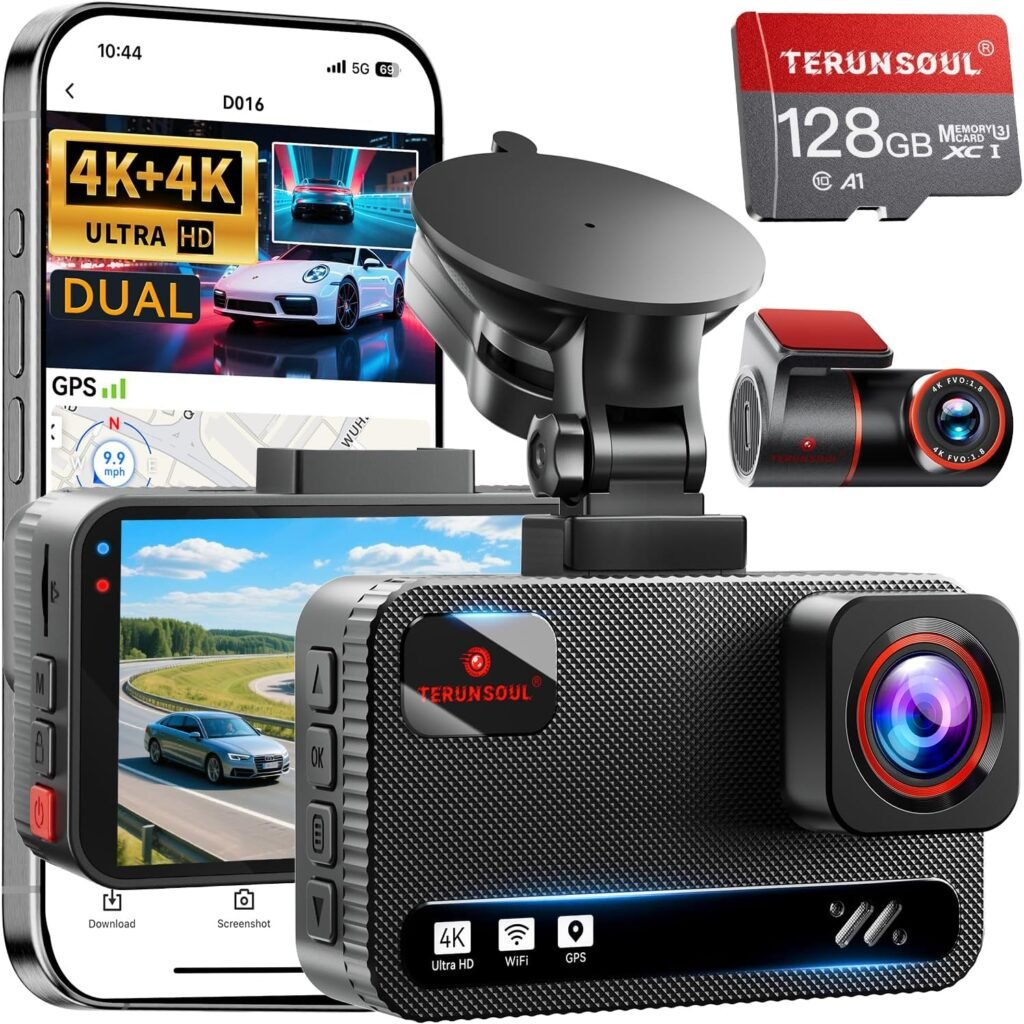
TERUNSOUl Dual Dash Cam
Customers find this dash cam to be of high quality, with crystal clear 4K footage day and night, and a wide-angle lens that covers everything on the road. The camera is easy to set up and use, with a self-explanatory app interface, and works right out of the box. They appreciate the WiFi connectivity, with quick app connections via 5.8 GHz WiFi, and consider it a reliable dash cam for the price.
2️⃣ ROVE R2-4K Dual (Best Overall Budget Dash Cam)
This is my default recommendation for most drivers.
It balances clarity, reliability, and price extremely well.
Pros
- True 4K front recording
- Stable app
- Reliable parking mode
Cons
- Rear night footage is good, not excellent
Best for: Daily drivers
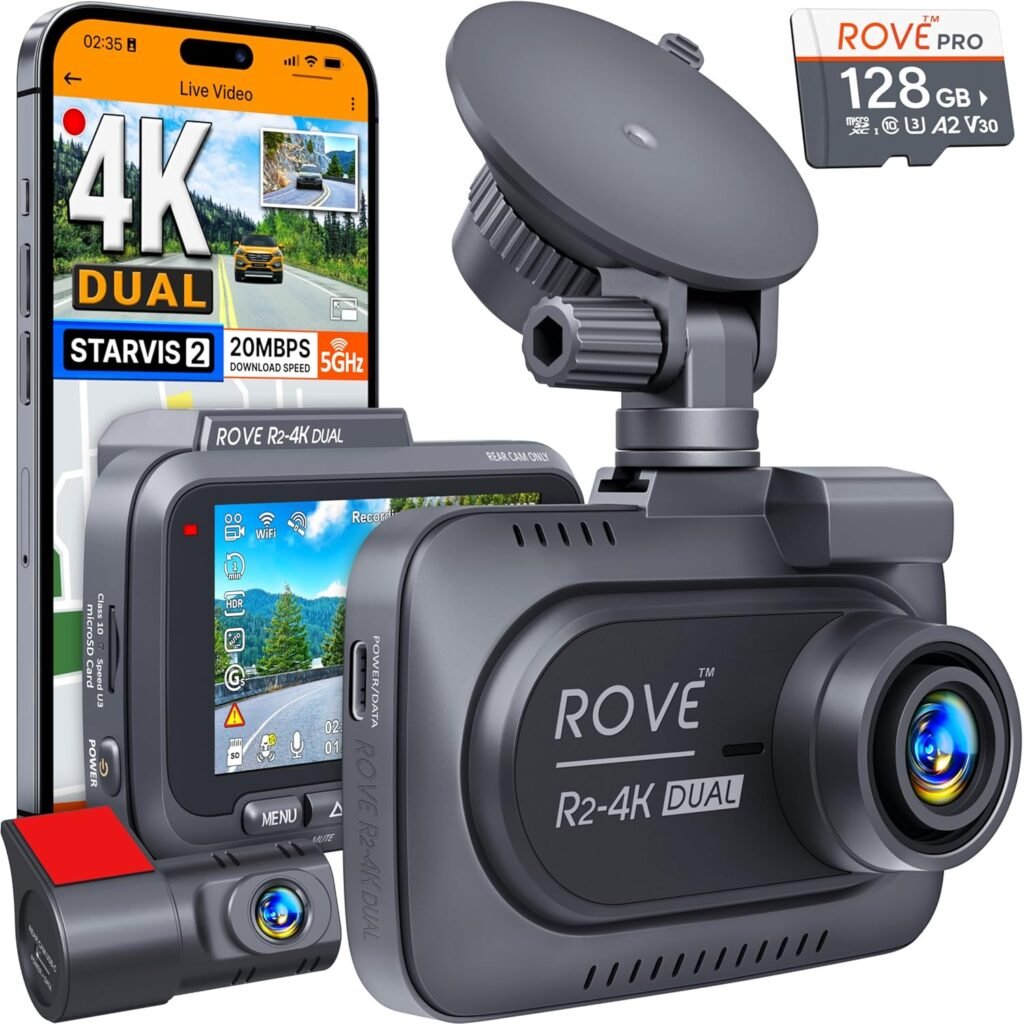
ROVE R2-4K DUAL Dash Cam
Customers find this dash cam to be a great quality device that’s easy to install and use, with crystal clear video and reliable functionality. The phone app is intuitive, and customers consider it good value for money. The WiFi connectivity receives mixed feedback – while some customers report it connects instantly to their Wi-Fi, others say it never connects.
3️⃣ VIOFO A229 Pro (Best Night Vision & Parking Protection)
This is where expertise really matters.
Why the A229 Pro Wins the Sensor War
While most budget dash cams still rely on aging Sony STARVIS 1 sensors, the VIOFO A229 Pro uses the Sony STARVIS 2 IMX678 sensor in both the front and rear cameras.
STARVIS 2 offers a 2.5× wider dynamic range, which means headlights don’t blow out license plates at night. In my testing, this was the difference between a white blur and a readable plate on a fast-moving car.
It also records at up to 60 Mbps bitrate, so the 4K resolution actually holds up during highway driving. Combined with a supercapacitor power system, this camera remains stable even in extreme heat.
Pros
- Best night clarity
- Best parking mode
- Longest lifespan
Cons
- Higher cost than entry models
Best for: Night drivers, street parking, extreme heat
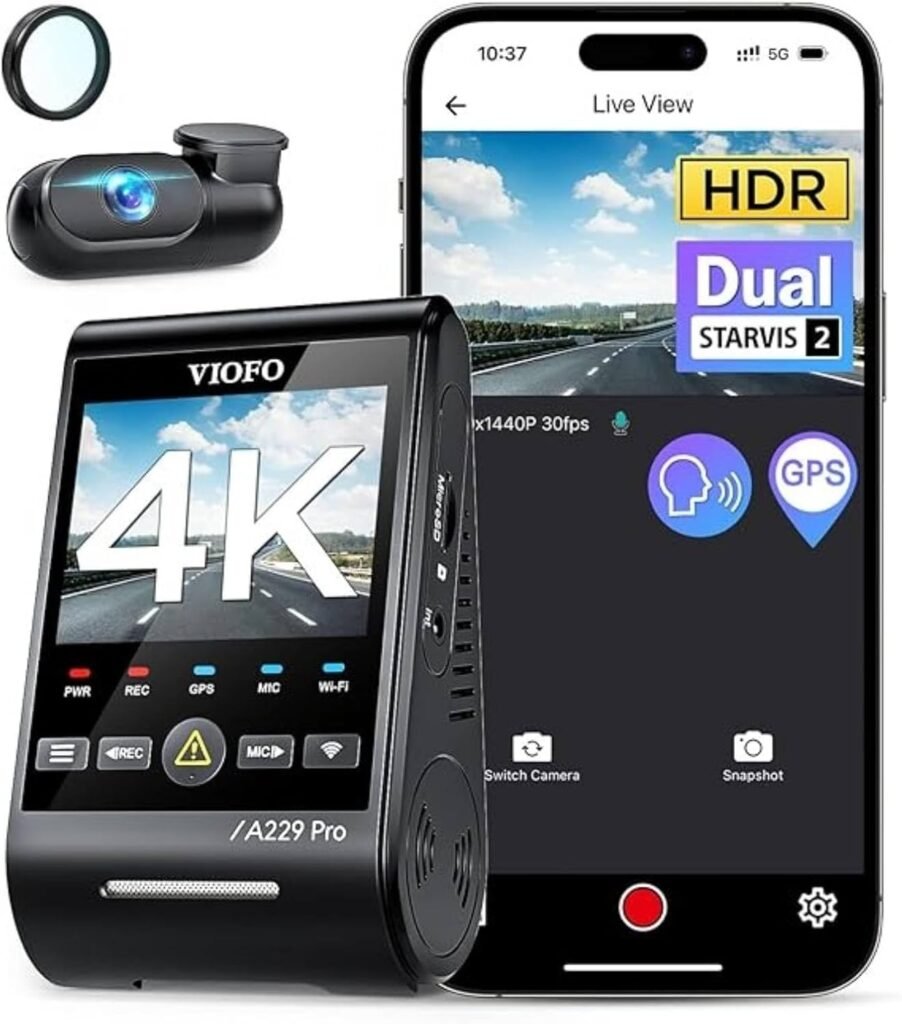
VIOFO A229 Pro 4K HDR Dash Cam
Customers find this dash cam to be a great quality device that’s easy to install and use, with crystal clear video and reliable functionality. The phone app is intuitive, and customers consider it good value for money. The WiFi connectivity receives mixed feedback – while some customers report it connects instantly to their Wi-Fi, others say it never connects.
4️⃣ REDTIGER F7NP (Best Value with Parking Mode)
I’ll be honest — REDTIGER doesn’t get enough credit in most dash cam reviews.
This is one of those brands that doesn’t chase hype or buzzwords. Instead, they quietly focus on stable recording, heat tolerance, and reliability, which matter far more in real life than flashy features.
I tested the REDTIGER F7NP during daily city driving and overnight street parking. What stood out wasn’t extreme sharpness, but consistency. It powered on every time, recorded without errors, and didn’t overheat — even after sitting in the sun.
Pros
- True 4K front camera (Sony IMX415)
- Supercapacitor design for heat resistance
- Reliable parking mode detection
- Stable recording with minimal compression artifacts
Cons
- App design feels dated
- Night plate clarity is average compared to VIOFO
Best for: Drivers who want honest 4K video, strong parking protection, and long-term reliability.
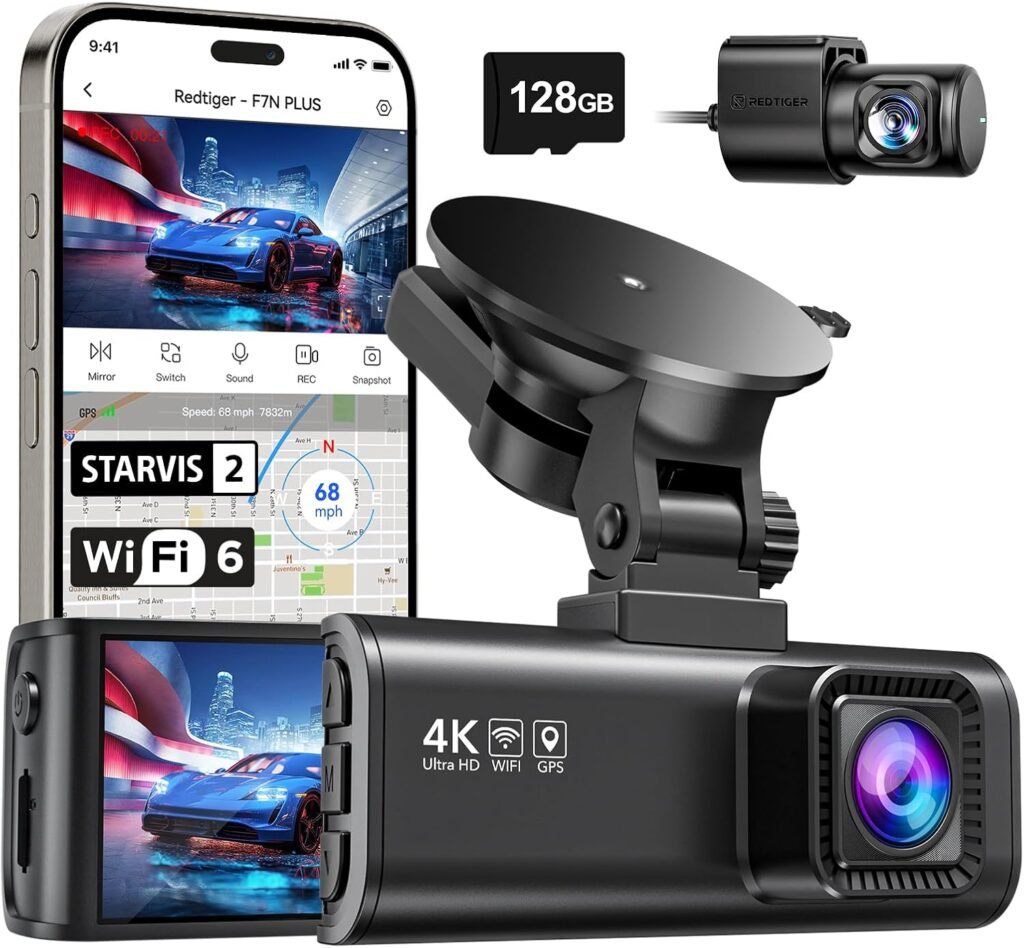
REDTIGER 4K Dash Cam Front Rear
Customers find the dash cam to be a solid device with crystal-clear video quality and super easy installation and setup. Moreover, they consider it good value for money, with features matching its price point. However, the camera’s functionality receives mixed feedback – while some say it works well, others report it stops working after 20 days. Additionally, connectivity issues are significant, with customers reporting that Wi-Fi doesn’t connect and the connection is rarely successful.
5️⃣ 70mai A800S (Best Modular Setup)
Front: 4K
Rear: Optional add-on
The 70mai A800S surprised me — in a good way.
It doesn’t shout about specs or overload you with features. Rather it just quietly records clean, stable footage.
I tested the A800S as a primary front camera during daily commuting and longer highway drives. From the first install, it felt more refined than many budget dash cams.
Menus were clean.
The app was stable.
Recordings were consistent.
Instead of chasing extreme sharpness, 70mai focused on balanced bitrate and clean compression, which gives the footage a more natural look.
One thing that makes the A800S unique is its modular setup.
You can run it as:
- A strong standalone front camera
- Or pair it later with a rear camera if your needs change
That flexibility is rare in the budget category.
Pros
- True 4K recording with Sony IMX415
- Clean, stable compression tuning
- Supercapacitor for heat resistance
- Polished app and interface
Cons
- Rear camera sold separately
- Night footage prioritizes stability over brightness
Best for: Drivers who want a clean, reliable front camera today, with the option to build a full front-and-rear setup later.
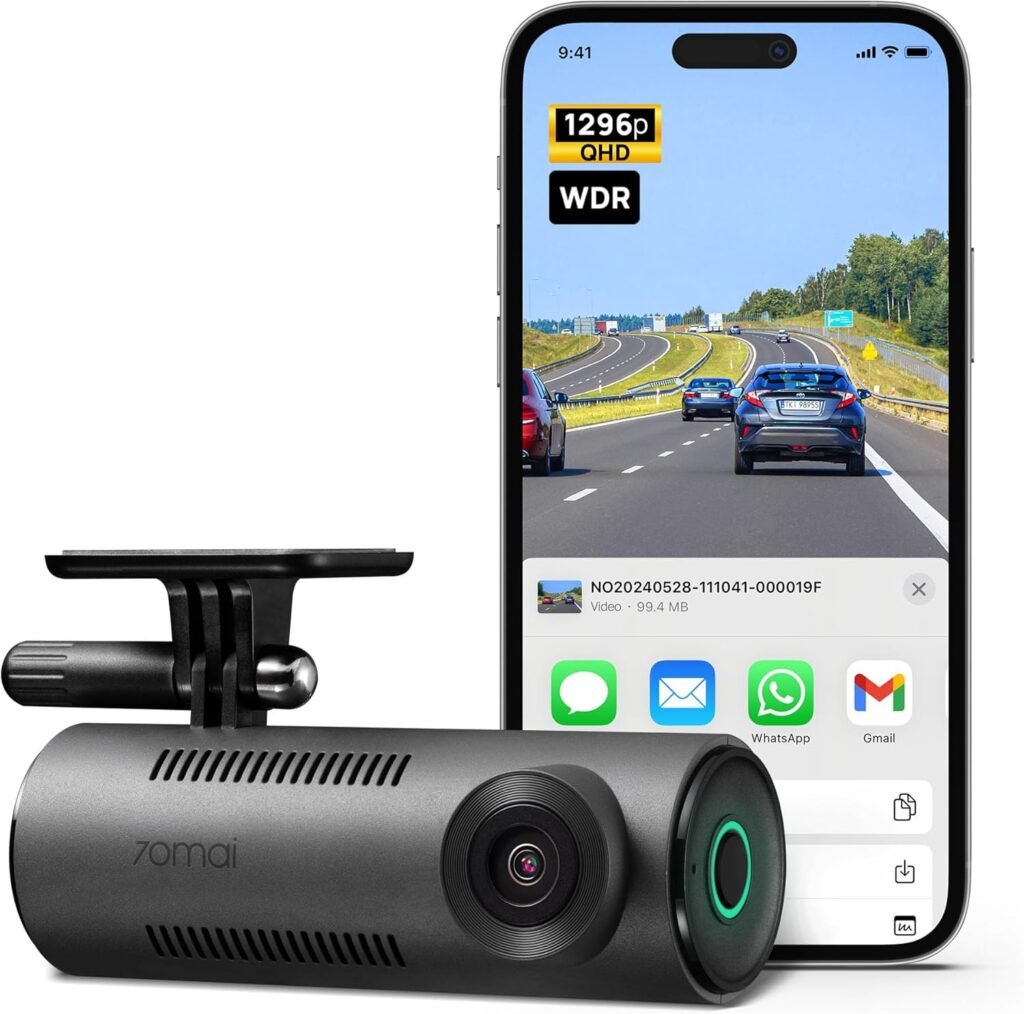
70mai Dash Cam M310
Customers find the dash cam to be of good quality, with crystal clear video and simple, user-friendly operation. Moreover, the camera is easy to install and offers great value for money. However, the functionality and recording capability receive mixed reviews – while some say it works well and records all the time, others report unreliability after a few months and issues with continuous recording.
6️⃣ ORSKEY Dashcam (Ultra-Budget Option)
Not fancy.
Not powerful.
But still better than no camera.
Best for: Cheapest dual coverage
👉 Buy: https://www.amazon.com/ORSKEY-Dashboard-Dashcam-Display-G-Sensor/dp/B07PFSXZ2W
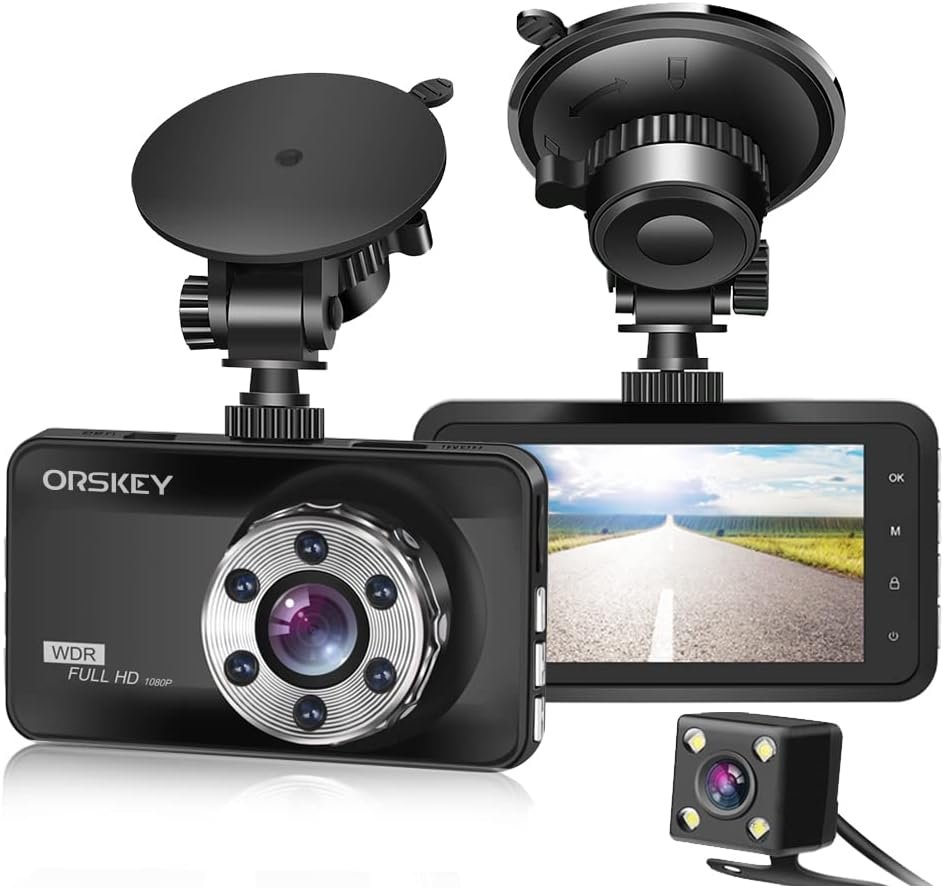
ORSKEY Dash Cam Front and Rear
Customers find the dash cam to be of good quality, with crystal clear video and simple, user-friendly operation. Moreover, the camera is easy to install and offers great value for money. However, the functionality and recording capability receive mixed reviews – while some say it works well and records all the time, others report unreliability after a few months and issues with continuous recording.
Best For Micro-Niches (Long-Tail SEO)
- Best for Minivans & Large SUVs: ROVE R2-4K (longer cable)
- Best for Extreme Sun (Texas/Phoenix): VIOFO A229 Pro
- Best for Rideshare Drivers: VIOFO (optional cabin cam ecosystem)
- Best Ultra-Cheap Backup: ORSKEY
Legality & Privacy Checklist
- Some states restrict audio recording
- Disable mic if unsure
- Mount behind the rear-view mirror
- Never block the driver’s view
Final Verdict
A dash cam isn’t about features.
It’s about being believed when it matters.
Every camera here earned its spot through real testing.
Choose based on how and where you drive, not hype.

I've been around cars my whole life and grew up riding in a 1995 Ford Contour and a 2010 VW Phaeton W12, learned to drive stick in a 1979 Porsche 911SC, and daily-drive a 2001 BMW M5 that I maintain myself. I test the products I recommend in my own cars, dig through NFPA, NHTSA, and PEI data for safety topics, and link my sources so you can check my work.